Media Report | AI-powered solutions are gaining momentum as pharmaceutical companies embrace a new era of digital marketing transformation
Over the past few years, pharmaceutical marketing remained hesitant about embracing digitalization; today, this issue is no longer controversial. The new focus lies in leveraging AI to maximize digital transformation and enhance marketing effectiveness to the fullest.
By 2025, large-scale models will be deployed at an accelerated pace.
By 2026, intelligent agents will become widely adopted.
The wave of technological iteration has propelled pharmaceutical companies' digital marketing into a more challenging phase.
As traditional marketing models become increasingly unsustainable, AI is further breaking down information barriers between healthcare providers and patients, shifting marketing strategies from extensive dissemination to data-driven, intelligent approaches. Meanwhile, stringent regulatory compliance requirements continue to compel the industry to return to its core mission of delivering patient benefits.
Under this trend, AI-powered digital marketing for pharmaceutical companies will become the key factor determining their competitiveness.
01 AI and Intelligent Agents: A New Variable in Digital Marketing for Pharmaceutical Companies
The reform of medical insurance payment methods, coupled with the normalization of centralized procurement, has continuously compressed the profit margins of pharmaceutical companies. Under compliance requirements, achieving effective communication with patients at low cost and high efficiency has become a long-term objective for pharmaceutical enterprises, making digital marketing a key strategy to overcome these challenges.
Historically, pharmaceutical companies' digital marketing efforts focused on migrating traditional marketing activities online, relying on manual resources and static data. While this approach effectively addressed issues of information delivery efficiency, it resulted in passive and homogeneous patient-care services with limited value potential. At this stage, many enterprises adopted a wait-and-see attitude toward digital marketing or implemented only superficial initiatives.
Currently, amid sustained stringent regulatory scrutiny and intensifying industry competition, digital marketing has evolved from an optional choice to an imperative requirement for pharmaceutical companies. Meanwhile, the widespread adoption of AI in industrial applications and its integration into daily life have further propelled pharmaceutical enterprises toward profound transformation opportunities in digital marketing.
Over the past two years, AI technologies—particularly large-scale models—have sparked a transformative wave across industries, reshaping workflows and transforming from cutting-edge innovations into everyday tools accessible to all. Entering 2026, the widespread adoption of intelligent agents will elevate AI's impact on both industries and daily life to new heights.
Chen Jing, Executive Director and Senior Vice President of HealthyWay Group, believes that the rapid evolution of AI technology has become the most significant factor in pharmaceutical companies' digital marketing landscape. "Especially with the widespread adoption of intelligent agents, the barrier to AI implementation has lowered, shifting core service processes in marketing from passive responses to proactive interventions."
For pharmaceutical companies 'digital marketing efforts, the fundamental value of AI lies in cost reduction and efficiency enhancement. It serves as a powerful tool across various processes—including content generation, data analysis, patient engagement management, and risk identification—replacing repetitive and time-consuming manual tasks. Take large-scale AI-based Q&A systems as an example: by transforming vast amounts of data into conversational responses, they not only swiftly address patients' or users' inquiries but also significantly alleviate the workload for physicians and other healthcare professionals.
Following the emergence of intelligent agents, AI can further transform analytical capabilities and data insights into autonomous execution capabilities. By continuously monitoring the dynamic interactions between physicians and patients in real time, these agents can collaboratively perform multiple tasks—including content generation, channel coordination, and follow-up engagement—ultimately shifting the paradigm from "people seeking information" to "information precisely reaching individuals." Taking patient management—a process that traditionally required significant resources with uncertain outcomes—as an example, the proactive intervention services provided by intelligent agents not only monitor medication adherence but also enable continuous health monitoring post-treatment, thereby unlocking additional opportunities for personalized marketing strategies.
In short, AI holds great potential to create significant value for pharmaceutical companies' digital marketing efforts.
02 How does the "Smart Hub" operate in this new era of transformation?
In the new wave of industry transformation driven by AI, digital health service platforms—leveraging their traffic access, service resources, and technological capabilities—can serve as a "smart hub" for pharmaceutical companies' digital marketing efforts, with HealthyWay serving as a prime example.
First, HealthyWay has established a systematic digital marketing ecosystem, accumulating vast medical-patient resources and covering diverse engagement scenarios. By the end of 2025, the platform boasted 934,000 registered physicians, 220 million registered users, and connections with 13,000 healthcare institutions. Its marketing channels span clinical settings, pharmacies, traffic platforms, primary care facilities, and retail outlets. Leveraging the Digital Specialty Alliance Center and Digital Disease Center, the platform enables refined operations across both physician and patient segments, forming a closed-loop marketing system.
Building upon its core channels—including clinical settings, pharmacies, and traffic platforms—HealthyWay is actively expanding its marketing reach, with retail outlets emerging as a key new distribution scenario. Chen Jing noted that pharmaceutical companies 'product portfolios encompass not only prescription drugs and OTC medications but also health consumer products, creating diverse sales scenarios; however, retail stores generally lack professional medical expertise and public health education capabilities. To address this, HealthyWay has partnered with Sam's Club and is advancing collaborations with Watsons to leverage professional medical expertise to bridge gaps across the supply chain and effectively reach health-conscious consumers.
The grassroots market represents another key focus for expansion. Financial reports indicate that in 2025, HealthyWay increased its R&D investment in technical solutions for primary healthcare consortia. Although the county-level market is vast, pharmaceutical companies face challenges in reaching this segment due to high accessibility costs. HealthyWay not only implements these technological solutions but also assists pharmaceutical firms in conducting digital marketing initiatives—including academic exchanges, drug education programs, and medication tracking—to strengthen their presence in this market tier.
As AI injects new momentum into the industry, HealthyWay is dedicated to building an AI-driven digital marketing ecosystem for pharmaceutical companies, enabling precise outreach to healthcare professionals and patients, consolidating multidimensional data assets, achieving intelligent marketing across the entire process, and establishing a new infrastructure for the sector.
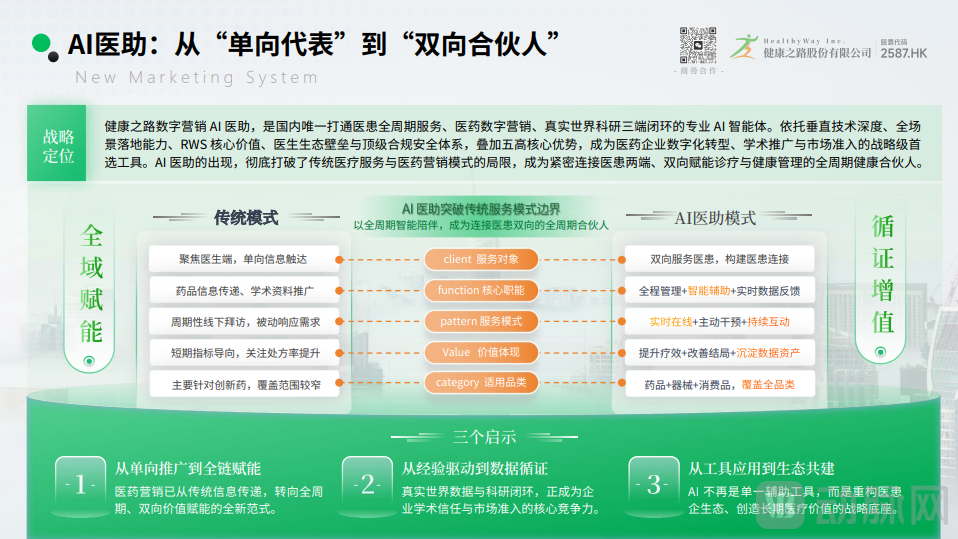
HealthyWay Digital Marketing: AI-Assisted Healthcare Solution
It is reported that HealthyWay has already deployed AI applications across its major marketing channels and will launch a series of AI-powered digital employee solutions in 2025, transforming AI capabilities into customizable, iterative, and quantifiable intelligent tools.
Chen Jing stated: "The intelligent agent directly delivers AI capabilities to users, such as providing physicians with on-demand customized AI assistants, significantly enhancing the flexibility and proactivity of patient management."
Specifically, flexibility is primarily demonstrated by AI's ability to establish personalized health profiles based on patients' individual characteristics and develop tailored intervention plans accordingly, triggering manual interventions when necessary to achieve truly customized management for each patient. Proactivity, on the other hand, means that AI no longer merely provides passive responses to patient inquiries but proactively delivers medication reminders, health monitoring alerts, and related content based on patient profiles, even dynamically adjusting interaction frequency as needed to ensure more precise and continuous follow-up services.
Financial reports indicate that HealthyWay's corporate services and digital marketing revenue reached RMB 1.36 billion in 2025, representing a year-on-year increase of 42.6%. Artificial intelligence (AI) played a pivotal role in driving this growth, even serving as a direct revenue contributor—AI-powered digital workforce services alone generated RMB 32.1 million in revenue that year. This trend demonstrates that AI-driven digital marketing solutions for pharmaceutical companies have gained initial industry recognition. Moreover, given the limited commercialization pathways for medical AI, these initiatives provide a viable business model reference.
Since 2026, HealthyWay has continuously enriched its AI-powered marketing content. For instance, it has introduced clinical pathways that focus on additional touchpoints in patient management, utilizing AI to monitor patients' adherence to continuous medication regimens, collect compliance data, and provide more granular marketing insights, thereby delivering tangible performance improvements for pharmaceutical companies.
03 In the era of AI, a more ideal marketing landscape is on the horizon.
Traditional pharmaceutical marketing was relationship-driven, relying on information asymmetry to maintain client relationships. Today, the widespread adoption of AI has further dismantled information barriers between healthcare providers and patients, shifting marketing models toward data-driven and intelligent approaches. The industry is accelerating its return to a value-centric focus on patient benefits, giving rise to a new marketing paradigm.
First, AI is being fully integrated into every aspect of pharmaceutical marketing, continuously enhancing its value.
As iteration cycles continue to shorten, AI technology will further expand its penetration across all aspects of pharmaceutical digital marketing, building upon existing application scenarios, while also deepening its implementation sophistication.
"The agent-based physician-patient collaboration system holds immense potential. For instance, future applications will enable interaction between physicians and patients through intelligent agents, leveraging health records to precisely recommend health-related products and guide wellness improvements—a development that will fundamentally reshape business models," stated Chen Jing. He further noted that during the previous era of digital marketing dominated by online channels, some pharmaceutical companies could still rely on traditional marketing approaches; however, with the accelerated pace of AI evolution, conventional marketing methods are becoming increasingly unsustainable.
Secondly, data assets will evolve from a concept into tangible assets, serving as a robust foundation for precision marketing.
Driven by AI, data can generate precise patient profiles and medication behavior patterns, supporting personalized marketing decisions. The accumulated data undergoes continuous iteration and optimization, forming a virtuous cycle that progressively enhances marketing efficacy.
However, the industry still faces the challenge of data fragmentation, with fragmented data being difficult to effectively aggregate—particularly due to the widespread lack of continuous patient data post-discharge. Since the concept of medical data assets was introduced, data collection has progressed relatively smoothly across regions, yet their application has not yet been widely adopted. Additionally, incomplete patient profiles and behavioral trajectories have become critical bottlenecks for precision marketing.
Chen Jing believes that the advancement of trusted data space development has created opportunities for industry breakthroughs. "Trusted data spaces can not only enhance hospital digital assets but also facilitate subsequent integration with pharmaceutical companies and unlock data value—this represents an inevitable trend."
Most importantly, full-cycle services aimed at maximizing patient benefits will become the core competitive advantage for pharmaceutical companies and marketing platforms.
Against the backdrop of continuously tightening pharmaceutical regulations and intensified anti-corruption efforts in healthcare, the traditional cash-based sales model is rapidly declining. Chen Jing emphasized that compliance constitutes the fundamental principle of pharmaceutical marketing, and the industry must return to its original mission by delivering valuable information to both healthcare providers and patients, thereby truly achieving patient benefits.
To this end, pharmaceutical companies will prioritize marketing resources toward patient services, leveraging professional platforms to design compliant digital marketing strategies that provide comprehensive one-stop services covering the entire process of prevention, diagnosis and treatment, medication management, and rehabilitation. The core objective is to enhance patient medication adherence and health benefits, thereby establishing long-term sustainable market competitiveness.
It is foreseeable that for participants actively embracing the trends of AI-driven transformation, a more ideal pharmaceutical marketing landscape is on the horizon: patients will receive continuous, personalized health support; physicians will be freed from routine follow-up tasks to focus on diagnosis and treatment; pharmaceutical companies will achieve greater commercial value while complying with regulations; and third-party platforms will establish a more solid position as "intelligent hubs." We anticipate accelerated adoption of such digital and intelligent marketing approaches, leading to the swift realization of this optimal framework.
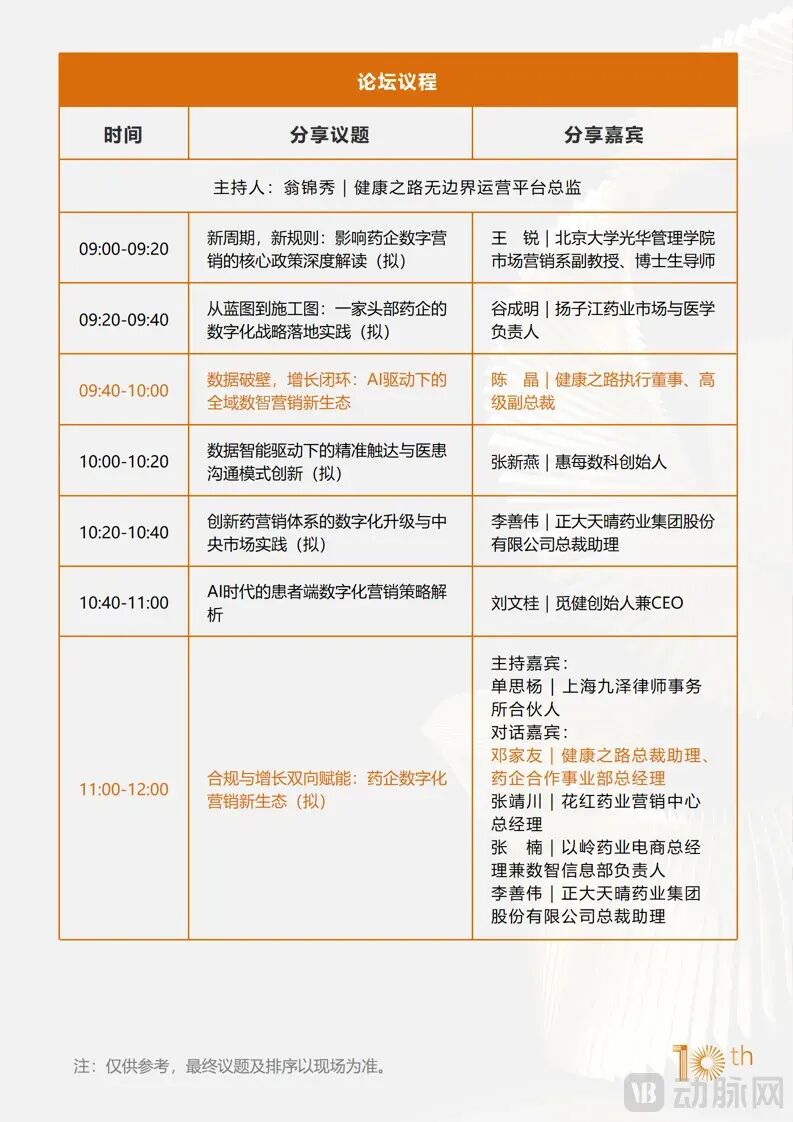
To delve deeper into the new landscape of AI-driven digital marketing, HealthyWay will co-host the "Pharmaceutical Companies Digital Marketing Forum" with Arterial Network during the 2026 Future Healthcare & Pharmaceutical Top 100 Conference.
Forum Time: May 19,09:00–12:00
Forum Address: Room 286, Buckingham Palace Hotel, Minhang District, Shanghai